
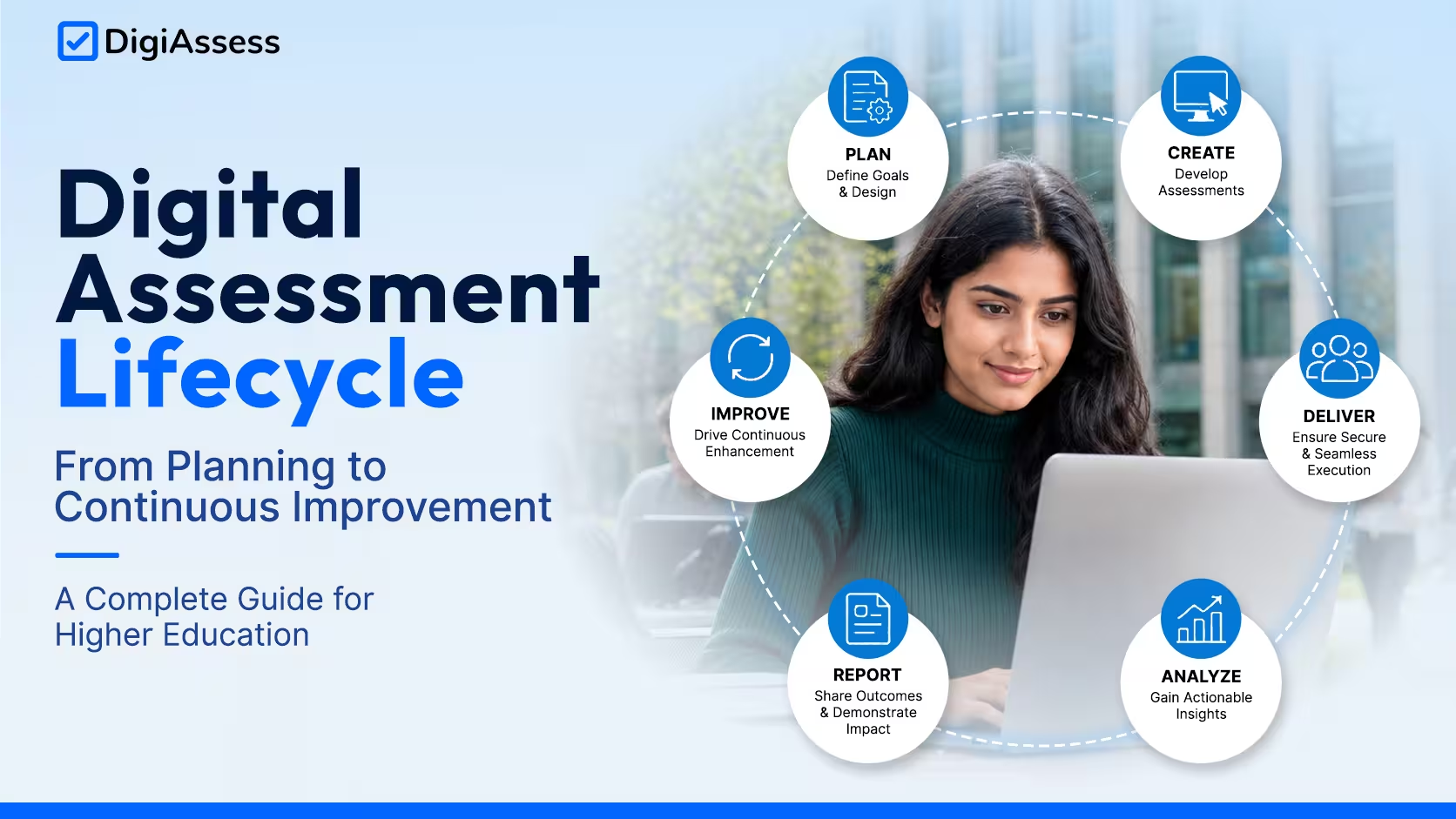
Assessment is one of the most important academic processes in a higher education institution. It determines how student learning is measured, how programs demonstrate achievement of learning outcomes, how faculty evaluate performance, and how institutions generate evidence for quality improvement and accreditation.
Yet, assessment is often managed as a collection of separate activities.
A faculty member may design an assessment in one system, create questions in another, schedule the examination through a separate process, conduct it using an examination platform, evaluate responses through another tool, export results into spreadsheets, and later use those results for programme-level reporting.
Each individual activity may work. The problem is the connection between them.
This is where the Digital Assessment Lifecycle becomes important.
A digital assessment lifecycle looks beyond the examination itself. It connects assessment planning, design, preparation, delivery, security, evaluation, analytics, reporting and continuous improvement into a connected academic process.
For universities, this creates an opportunity to move from simply conducting digital examinations to managing assessment as an institution-wide, evidence-driven process.
In this guide, we explain the digital assessment process in higher education, the major stages of the Digital Assessment Lifecycle, the role of governance and technology at each stage, and how institutions can use assessment data to improve academic quality and learning outcomes.
The Digital Assessment Lifecycle covers assessment from planning through continuous improvement, not just examination delivery.
A complete assessment lifecycle in higher education connects academic objectives, assessment design, delivery, evaluation, analytics and improvement.
Digital assessment works best when assessment data remains connected throughout the lifecycle.
Governance, security, accessibility, quality assurance and data integrity should operate across the entire lifecycle.
Digital assessment can support theory, practical, clinical, workplace-based, formative and summative assessments.
Assessment analytics can help institutions move from simply reporting marks to understanding learning outcomes and competencies.
An effective lifecycle should connect assessment evidence with curriculum improvement, programme review and accreditation requirements.
AI can support multiple stages of assessment, but human oversight, transparency and governance remain essential.
The end of an assessment is not the end of the lifecycle. Results should inform the next cycle of planning and improvement.
The Digital Assessment Lifecycle is the connected process through which an institution plans, designs, prepares, delivers, secures, evaluates, analyzes, reports and improves its assessments using digital systems and structured data.
Instead of treating an assessment as a single event, the lifecycle treats it as a continuous academic process.
A simplified model is:
Plan → Design → Prepare → Deliver → Secure → Evaluate → Analyze → Report → Improve → Plan
The cycle then continues.
This distinction matters because an assessment produces much more than a final score.
It can generate evidence about:
Student achievement
Course learning outcomes
Programme learning outcomes
Competencies
Assessment quality
Question performance
Faculty workload
Student performance patterns
Academic progression
Curriculum effectiveness
Programme quality
Accreditation evidence
When these outputs remain connected, assessment becomes a source of institutional intelligence rather than simply a mechanism for assigning marks.
For institutions evaluating a digital assessment platform, the question should not only be whether a platform can conduct an examination. It should also be whether it can support the broader assessment management process from planning through improvement.
A digital examination is one part of the broader assessment lifecycle.
An online examination generally focuses on delivering an assessment digitally. This may include candidate authentication, question delivery, timing, submission, proctoring and result generation.
The Digital Assessment Lifecycle goes further.
It begins before the examination and continues after results are published.
For example:
Assessment requirement → Blueprint → Question development → Outcome mapping → Configuration → Scheduling → Delivery → Evaluation → Results → Analytics → Outcome measurement → Reporting → Improvement
This means that an institution can use digital technology not only to conduct assessments but also to understand whether those assessments are valid, aligned, secure, measurable and useful for academic improvement.
For a deeper explanation of this distinction, see the Digital Assessment vs Online Examination resource.
Higher education assessment becomes increasingly complex as institutions grow.
A university may have multiple campuses, programmes, departments, assessment types, academic calendars, evaluators and regulatory requirements.
The complexity becomes even greater when institutions need to manage:
Large student populations
Multiple assessment formats
Practical and clinical assessments
Continuous and formative assessments
High-stakes examinations
Remote and onsite assessments
Different grading models
Multiple learning-outcome frameworks
Accreditation reporting
Different institutional policies
External assessment components
Managing these processes through disconnected tools can create data silos and duplicated work.
A connected digital assessment workflow provides a way to link the different stages.
The objective is not simply automation.
The larger objective is continuity.
The information created during assessment design should remain useful during delivery, evaluation, analytics and reporting.
Similarly, insights generated after an assessment should influence future assessment planning.
That creates a closed-loop assessment cycle in higher education.
Stage | Primary Focus | Typical Outputs |
Plan | Objectives, requirements and assessment strategy | Assessment plan |
Design | Blueprint, outcomes and assessment structure | Assessment specification |
Prepare | Questions, resources and configuration | Ready-to-deliver assessment |
Deliver | Assessment execution | Student responses and evidence |
Secure | Integrity, authentication and control | Trusted assessment record |
Evaluate | Marking, grading and moderation | Evaluated responses |
Analyze | Performance and outcome analysis | Assessment intelligence |
Report | Results, outcomes and evidence | Institutional reports |
Improve | Review, intervention and refinement | Improvement actions |
These stages should not be treated as isolated steps.
They form a connected system in which information and decisions flow from one stage to the next.
The Digital Assessment Lifecycle begins with planning.
Before creating questions or scheduling an examination, institutions need to determine what the assessment is intended to measure and how the assessment fits within the broader academic structure.
Assessment planning can involve:
Course and programme requirements
Learning outcomes
Assessment methods
Assessment weightage
Academic calendars
Student cohorts
Assessment schedules
Delivery modes
Resources
Evaluators
Security requirements
Institutional policies
For outcome-based education, planning should also establish how the assessment will contribute to measuring Course Learning Outcomes (CLOs), Programme Learning Outcomes (PLOs), competencies or other institutional frameworks.
A well-planned assessment therefore starts with the academic purpose rather than the technology.
A structured assessment plan should clarify:
What should students demonstrate?
Which learning outcomes are being measured?
Which assessment method is appropriate?
How will achievement be measured?
Who is responsible for the assessment?
What policies apply?
What evidence needs to be generated?
How will the results be used later?
This creates the foundation for the rest of the lifecycle.
Once the purpose is established, the next stage is assessment design.
Assessment design determines how the intended learning outcomes will actually be measured.
This is where institutions develop assessment specifications, blueprints, question structures, rubrics and evaluation criteria.
A strong assessment design should establish alignment between:
Learning Outcomes → Assessment Methods → Questions/Tasks → Evaluation Criteria → Evidence
For example, if a course outcome requires students to demonstrate clinical decision-making, a simple recall-based multiple-choice question may not provide sufficient evidence.
The assessment method needs to match the intended competency.
Assessment blueprinting
Question types
Difficulty levels
Cognitive taxonomy
Learning outcome mapping
Competency mapping
Mark distribution
Rubrics
Evaluation criteria
Number of questions
Time allocation
Assessment components
Moderation requirements
This is one of the areas where a digital assessment platform can provide value beyond basic examination delivery.
A structured system can connect questions, assessment specifications and learning outcomes instead of treating them as separate records.
Institutions can explore the DigiAssess Features to understand how assessment creation, question banks, evaluation, outcomes, analytics and other capabilities fit together.
After the assessment is designed, it needs to be prepared for actual delivery.
Preparation converts the assessment specification into an operational assessment.
This can include:
Question creation
Question-bank management
Question review
Blueprint validation
Question tagging
Outcome mapping
Rubric configuration
Candidate selection
Assessment configuration
Marks and weightage
Instructions
Accessibility requirements
Security settings
Evaluation workflows
Question banks become particularly important at institutional scale.
Instead of creating every assessment from scratch, institutions can maintain structured repositories of questions categorized by factors such as:
Course
Topic
Learning outcome
Difficulty
Cognitive level
Question type
Competency
Assessment purpose
This can improve consistency and support better assessment design over time.
Preparation is also the stage where institutions should perform quality checks before an assessment becomes live.
The delivery stage is where students actually participate in the assessment.
Digital assessment can support different delivery environments depending on institutional requirements.
These may include:
Onsite assessments
Remote assessments
Online assessments
Offline assessments
Hybrid assessments
Computer-based testing
BYOD environments
Test-centre delivery
Practical assessments
Clinical assessments
Workplace-based assessments
The objective is to deliver the assessment according to the defined academic and operational requirements.
At scale, delivery involves much more than displaying questions on a screen.
Institutions may need to manage:
Candidate authentication
Scheduling
Room allocation
Test centres
Devices
Proctors
Assessment sessions
Late entry
Time extensions
Technical incidents
Candidate support
Live monitoring
This is why a university assessment lifecycle should include operational management as well as academic design.
The Assess Anyone, Anywhere approach provides a useful reference for institutions considering multiple assessment environments.
Security is not a separate concern that begins when the examination starts.
It should be considered throughout the lifecycle.
However, the delivery stage is where many security controls become operationally visible.
A secure digital assessment environment may involve:
Authentication
Identity verification
Access controls
Secure browsers
Proctoring
Activity monitoring
Device controls
Question security
Encryption
Audit trails
Incident management
Role-based permissions
Security should be proportional to the assessment risk.
A low-stakes formative quiz may require a different security model from a high-stakes professional examination.
The important principle is that integrity controls should support the intended assessment purpose without unnecessarily compromising accessibility or usability.
Security also needs to extend beyond the student interface.
Institutional users, evaluators, administrators and technical teams should have appropriate permissions based on their roles.
This is where assessment governance becomes closely connected with assessment security.
After students submit their responses, the next stage is evaluation.
Evaluation may be straightforward for objectively scored assessments, but more complex for assessments requiring human judgment.
Higher education institutions may need to support:
Automated scoring
Manual marking
Rubric-based evaluation
AI-assisted evaluation
Multiple evaluators
Moderation
Re-evaluation
Practical assessment
Clinical assessment
Portfolio evaluation
Workplace-based assessment
Evaluation needs to be consistent with the assessment design.
If a rubric was established during the design stage, it should remain connected to the evaluation process.
If multiple evaluators are involved, institutions may also need mechanisms for moderation and review.
This connection between design and evaluation is important because it reduces the risk of assessment criteria becoming disconnected from the original learning objectives.
Evaluation produces results.
Analysis turns those results into information that can support academic decisions.
This is one of the most valuable stages in the Digital Assessment Lifecycle because assessment data can reveal patterns that are difficult to identify through marks alone.
Institutions may analyze:
Student performance
Question performance
Difficulty
Discrimination
Reliability
Learning outcome attainment
Competency performance
Grade distribution
Cohort performance
Topic-level performance
Assessment trends
Faculty or evaluator patterns
For example, if students consistently perform poorly on questions mapped to one learning outcome, the institution can investigate whether the issue is related to:
Student understanding
Question difficulty
Teaching coverage
Assessment design
Curriculum alignment
Evaluation consistency
This changes the role of assessment analytics.
Instead of asking only:
“What mark did the student receive?”
institutions can ask:
“What does the assessment evidence tell us about learning?”
That is a much more strategic use of assessment data.
Reporting converts assessment information into usable evidence for different stakeholders.
A student may need an individual performance report.
A faculty member may need course-level insights.
A programme leader may need learning outcome attainment.
An academic administrator may need institutional trends.
A quality team may need evidence for programme review.
An accreditation team may need structured documentation showing how assessment evidence supports continuous improvement.
Therefore, one assessment can require multiple reporting perspectives.
Student reports
Course reports
Programme reports
Outcome attainment reports
Competency reports
Item analysis reports
Grade distribution
Assessment performance reports
Accreditation evidence
Improvement reports
Longitudinal performance analysis
The important point is that reporting should not require institutions to manually reconstruct the assessment history.
The evidence should already exist within the lifecycle.
This is where the lifecycle becomes a continuous improvement system.
The purpose of assessment is not simply to produce results.
Assessment evidence should inform academic decisions.
Institutions can use assessment data to identify:
Learning gaps
Weak assessment items
Curriculum gaps
Outcome attainment issues
Evaluation inconsistencies
Student support requirements
Assessment design issues
Areas requiring remediation
Opportunities for curriculum improvement
For example, if a group of questions consistently demonstrates poor discrimination, the institution may review those items.
If students repeatedly underperform against a particular learning outcome, faculty may examine instructional strategies or curriculum coverage.
If a program consistently shows gaps in one competency, the program team may consider curriculum or assessment changes.
The improvement stage therefore feeds directly into the next planning cycle.
That creates:
Assessment → Evidence → Analysis → Decision → Improvement → Next Assessment
This is the essence of a continuous assessment lifecycle management approach.
A major advantage of digital assessment is the possibility of maintaining continuity of data.
A connected assessment data flow can look like this:
Institutional Structure → Programme & Course Outcomes → Assessment Specification → Blueprint → Question / Item Bank → Assessment Configuration → Candidate → Assessment Attempt → Response / Evidence → Evaluation → Result → Analytics → Outcome / Competency Evidence → Report → Improvement → Next Assessment Plan
The value is not simply that each component is digital.
The value comes from the connections between them.
When assessment data is fragmented, institutions often need manual exports, spreadsheets and reconciliation.
When data is connected, the institution can trace how an assessment was designed, delivered, evaluated and used for improvement.
This concept is closely aligned with the broader Assessment Operating System approach, which connects assessment design, controlled execution, evaluation, outcome measurement, analytics and continuous improvement.
Governance should not be treated as another stage.
It should operate across the entire lifecycle.
Assessment governance determines who can do what, under which rules, with what approvals and with what level of accountability.
A governance framework may cover:
Institutional policies
Roles and permissions
Approval workflows
Assessment ownership
Version control
Data access
Privacy
Security
Auditability
Exception handling
Incident management
Quality assurance
Accreditation evidence
For example, an institution may have a policy defining who can approve an examination.
In a fragmented environment, that policy may exist only in a document.
In a governed digital environment, the workflow can incorporate the approval requirement directly.
This creates a distinction between:
Policy documented
and
Policy operationalized.
For a deeper look at this concept, see the Assessment Governance in Higher Education guide.
Accessibility should not be added immediately before an assessment is launched.
It should be considered from assessment planning through delivery and reporting.
Accessibility can affect:
Question design
Content formats
User interfaces
Navigation
Timing
Assistive technology
Alternative formats
Assessment instructions
Authentication
Communication
Result reporting
A technically digital assessment is not automatically an accessible assessment.
Institutions should evaluate accessibility requirements according to their student population, assessment type, institutional policy and applicable standards.
Accessibility also needs to be considered when using AI-powered assessment technologies.
For example, institutions should evaluate whether automated monitoring, identity verification or other controls create barriers for particular student groups.
DigiAssess provides an Accessibility Statement that institutions can review alongside their own accessibility requirements.
AI should not be treated as the lifecycle itself.
It is better understood as a capability that can support multiple stages.
AI may assist with:
AI can help identify patterns in previous assessments and support planning decisions.
AI can assist with question generation, question variation, outcome mapping and assessment blueprinting.
AI can support question classification, tagging and quality checks.
AI can support monitoring, anomaly detection and integrity workflows.
AI-assisted evaluation can support certain assessment types, particularly when structured rubrics and human oversight are available.
AI can help identify patterns across large assessment datasets.
AI can support natural-language summaries and stakeholder-specific insights.
AI can help identify recurring learning gaps or assessment-quality issues that deserve human review.
However, AI should not remove academic accountability.
Institutions still need to consider:
Human oversight
Transparency
Explainability
Bias
Privacy
Data governance
False positives
Evaluation validity
Auditability
The strongest model is therefore not:
AI replaces assessment decisions.
It is:
AI supports assessment decisions within a governed academic framework.
The transition from paper to digital assessment is often described as a technology upgrade.
In reality, the difference can be much broader.
Paper-Based Assessment | Digital Assessment |
Physical question papers | Digital assessment content |
Manual distribution | Controlled digital delivery |
Physical answer scripts | Digital responses |
Manual marking or scanning | Digital evaluation workflows |
Manual result consolidation | Automated result processing |
Limited immediate analytics | Detailed assessment analytics |
Manual evidence collection | Structured digital evidence |
Difficult longitudinal analysis | Longitudinal data analysis |
Physical storage | Digital records |
Manual reporting | Automated reporting |
However, digitizing paper does not automatically create a mature digital assessment process.
If an institution simply converts a paper examination into an online test but continues to rely on spreadsheets and disconnected reporting, only part of the process has been digitized.
The real transformation occurs when the digital assessment process in higher education becomes connected from planning to improvement.
The terms digital assessment and online examination are sometimes used interchangeably, but they represent different scopes.
An online examination is primarily concerned with delivering an assessment electronically.
A digital assessment ecosystem can encompass:
Assessment planning
Blueprinting
Question banks
Outcome mapping
Assessment configuration
Scheduling
Secure delivery
Evaluation
Moderation
Analytics
Reporting
Accreditation evidence
Continuous improvement
Therefore:
Online examination = a delivery method
Digital assessment lifecycle = a connected institutional process
This distinction becomes especially important for universities managing multiple assessment types.
An LMS remains an important component of the academic technology ecosystem.
LMS platforms can support:
Course content
Assignments
Quizzes
Learning activities
Gradebooks
Feedback
Student engagement
The question is not whether an LMS is useful.
The question is whether an LMS alone provides every capability required for institution-wide assessment governance.
Depending on institutional requirements, specialist assessment capabilities may be needed for areas such as:
High-stakes examinations
Complex assessment scheduling
Advanced proctoring
Test-centre management
Offline assessment
Specialized practical or clinical assessment
Advanced assessment analytics
Outcome measurement
Assessment governance
Accreditation evidence
This is why the modern higher education technology architecture can be viewed as interconnected systems rather than one system replacing everything else.
The LMS supports learning.
The SIS manages student and academic records.
A dedicated assessment layer can connect assessment operations, evidence, outcomes and governance.
The Assessment Operating System model explains this assessment layer in greater detail.
Universities often face a tension between central control and departmental flexibility.
A central academic team may need consistent institutional policies.
At the same time, individual faculties and departments may need flexibility to create and manage assessments according to their disciplines.
A mature university assessment lifecycle should support both.
The model can be:
Centralized Governance + Decentralized Execution + Institutional Visibility
For example:
Institutional policies
Governance rules
Security standards
Assessment frameworks
Reporting standards
Assessment design
Question creation
Outcome mapping
Evaluation
Moderation
Scheduling
Delivery
Candidate management
Evaluation
Incident handling
Analytics
Outcome measurement
Quality review
Accreditation evidence
Continuous improvement
This approach allows institutions to maintain consistency without unnecessarily centralizing every academic decision.
The Digital Assessment Lifecycle should not be limited to traditional theory examinations.
Higher education institutions increasingly use different forms of assessment.
These can include:
Formative assessment
Summative assessment
Continuous assessment
Practical assessment
Clinical assessment
OSCE
Workplace-based assessment
Portfolio assessment
Competency assessment
Viva or oral assessment
Theory examinations
The lifecycle remains relevant across these models, although the individual workflows may differ.
For example, a clinical assessment may require structured observations and competency evaluation.
A theory examination may rely heavily on question banks, blueprinting and automated scoring.
A workplace assessment may require supervisor input, evidence capture and longitudinal competency tracking.
A mature assessment platform should therefore support different assessment modalities while maintaining consistent governance and data continuity.
Quality assurance should exist throughout the lifecycle rather than being performed only after results are generated.
A useful model is:
Design QA → Preparation QA → Delivery QA → Evaluation QA → Analytics QA → Reporting QA → Improvement QA
Are assessment methods aligned with learning outcomes?
Are questions, blueprints, rubrics and configurations correct?
Was the assessment conducted according to approved requirements?
Was marking consistent and properly moderated?
Are the calculations and interpretations reliable?
Does the evidence accurately represent assessment performance?
Were findings translated into appropriate academic actions?
This approach helps institutions treat quality as a continuous process.
Assessment data becomes particularly valuable when it can support programme-level and institutional-level quality processes.
A useful evidence chain is:
Assessment Activity → Evidence → Outcome Measurement → Programme Review → Improvement
For example, an institution may need to demonstrate:
What learning outcomes were defined.
Which assessments measured those outcomes.
What evidence was collected.
How student performance was evaluated.
What level of outcome attainment was observed.
What gaps were identified.
What improvements were implemented.
How the improvements were subsequently evaluated.
This creates a stronger connection between assessment and quality assurance.
Digital systems can help institutions organize and retrieve this evidence more efficiently, but technology itself does not guarantee accreditation.
Accreditation depends on institutional processes, academic practices, evidence quality and compliance with the relevant framework.
The Digital Assessment Lifecycle does not exist in isolation from the wider academic technology environment.
Universities commonly operate multiple systems, including:
SIS
LMS
ERP
Assessment systems
Identity platforms
Communication systems
Quality systems
Accreditation systems
Data platforms
The challenge is making these systems work together without creating unnecessary duplication.
Integration may involve:
APIs
Event-based integration
Data synchronization
Identity integration
Structured assessment-data exchange
Reporting interfaces
The important principle is that integration should preserve data ownership, security, governance and traceability.
Institutions should not measure digital assessment success only by asking whether examinations were conducted successfully.
A broader measurement framework can include five categories.
Assessment turnaround time
Scheduling efficiency
Faculty workload
Examination incidents
Resource utilization
Evaluation turnaround
Blueprint coverage
Question quality
Difficulty levels
Discrimination
Reliability
Moderation variance
CLO attainment
PLO attainment
Competency achievement
Student progression
Learning gaps
Student usability
Faculty usability
Accessibility
Support requests
Assessment completion experience
Approval completion
Audit completeness
Policy adherence
Version traceability
Incident resolution
Evidence availability
This gives institutions a more complete picture of whether their assessment lifecycle management is actually improving academic operations.
A connected assessment ecosystem should bring together the academic, operational and analytical dimensions of assessment.
DigiAssess positions its assessment environment around this broader lifecycle.
Instead of treating assessment as only examination delivery, the platform connects areas such as:
Assessment planning
Blueprinting
Question-bank management
Outcome mapping
Assessment preparation
Scheduling
Secure delivery
Evaluation
Assessment analytics
Results
Outcome measurement
Accreditation reporting
Continuous improvement
The objective is to create continuity between what an institution plans, what it assesses, what students demonstrate, what evaluators record and what academic leaders ultimately learn from the data.
For institutions evaluating a broader digital assessment platform, the DigiAssess Platform provides a detailed view of the assessment architecture and lifecycle.
Consider a university preparing a major programme assessment.
The academic team first defines the learning outcomes and assessment requirements.
The assessment team then creates a blueprint and selects appropriate questions.
Questions are mapped to outcomes and other relevant frameworks.
The assessment is configured and scheduled.
Students complete the assessment through the appropriate delivery environment.
Security and integrity controls operate during the assessment.
Responses move into the evaluation workflow.
Results are generated and analyzed.
The institution reviews question performance and outcome attainment.
Program leaders identify areas requiring improvement.
Those findings influence future curriculum and assessment planning.
The next assessment cycle therefore starts with better information than the previous one.
That is the difference between a digital examination workflow and a mature Digital Assessment Lifecycle.
The system does not simply digitize an existing process.
It connects the process.
The future of digital assessment in higher education is not simply about replacing paper examinations with online examinations.
The larger opportunity is to connect the complete assessment process.
A mature Digital Assessment Lifecycle links:
Planning → Design → Preparation → Delivery → Security → Evaluation → Analytics → Reporting → Improvement
More importantly, it connects these activities with the academic objectives behind them.
Assessment should be connected to learning outcomes.
Learning outcomes should be connected to evidence.
Evidence should be connected to analytics.
Analytics should inform academic decisions.
Academic decisions should drive improvement.
And improvement should influence the next assessment cycle.
This creates a continuous loop:
Assess → Measure → Understand → Improve → Assess Again
For universities, this approach can help move assessment from a largely operational activity to a more connected source of academic intelligence.
The key question is therefore not simply:
“Can we conduct our examinations digitally?”
It is:
“Can we manage, govern, measure and continuously improve assessment across the institution?”
That is the real purpose of a connected Digital Assessment Lifecycle.
And for institutions building a modern academic technology ecosystem, the goal should not be digital assessment alone.
It should be connected, governed, measurable and continuously improving assessment.
Fill out the form to see how DigiAssess transforms academic operations