
Every assessment produces more than a score.
It creates evidence about what students know, what they can demonstrate, where they are progressing, and where additional attention may be needed.
For colleges and universities, the challenge is making that evidence easier to capture, evaluate, understand, and use.
This is where digital assessment can create value.
The shift from traditional assessment processes to digital assessment is not simply about replacing paper with screens. When implemented effectively, digital assessment can reduce administrative effort, accelerate feedback, provide greater visibility into student performance, support different ways of demonstrating learning, and make assessment evidence more accessible for academic decision making.
The benefits can be felt across the institution, from students and faculty to program leaders, assessment teams, Institutional Effectiveness teams, and academic leadership.
Research and higher education practice support this broader view. The OECD Digital Education Outlook 2023 examines how digital technologies can expand assessment possibilities, generate richer information, support more timely feedback, and enable new approaches to assessment, while also emphasizing the importance of thoughtful implementation. (OECD)
So what changes when assessment becomes digital?
Here are ten benefits that matter to colleges and universities.
Colleges and universities are modernizing assessment because they increasingly need to:
Assessment is evolving from an examination event into a broader source of institutional evidence.
Traditional systems can leave assessment data fragmented across departments, applications, and processes.
Digital exam delivery is only one part of assessment modernization.
Connected assessment links evidence with learning outcomes, competencies, programs, and institutional improvement.
Assessment intelligence can support academic quality, accreditation, governance, and continuous improvement.
The future of university assessment is not simply digital. It is connected, measurable, and strategic.
Assessment involves far more work than the assessment itself.
Questions need to be prepared and reviewed. Students need to be scheduled. Assessments need to be delivered. Responses need to be evaluated. Results need to be processed. Reports need to be prepared.
When these activities depend heavily on paper, spreadsheets, email, and manual coordination, faculty and administrative teams can spend significant time managing the process around assessment.
Digital assessment can reduce some of that operational burden by bringing assessment activities into more structured workflows.
The result is not simply greater efficiency.
It can mean less time spent coordinating assessment and more time available for academic work.
RM Assessment’s overview of digital assessment benefits similarly identifies reduced manual administration, streamlined assessment management, faster marking, and improved visibility among the benefits of digital assessment. (RM)
The value of feedback can depend partly on when it arrives. When evaluation takes too long, students may have already moved on to the next topic, activity, or assessment before they understand where improvement is needed.
Digital assessment can shorten the distance between: Assessment → Evaluation → Feedback
Automated evaluation can provide faster results for appropriate question types, while digital rubrics, annotations, structured evaluation, and feedback workflows can help faculty manage other forms of assessment more efficiently.
For students, this can mean receiving useful information sooner.
For faculty, it can mean identifying performance patterns earlier.
The University of York’s Digital Assessment and Feedback guidance discusses benefits associated with digital submission and feedback, including flexibility and different approaches to providing feedback.
Technology does not make feedback meaningful by itself.
But it can help make meaningful feedback available sooner.
Assessment processes can become increasingly complex as institutions grow.
Different departments may use different workflows. Multiple faculty members may be involved in preparation and evaluation. Programs may operate across campuses. Different assessment types may require different processes.
Digital assessment can provide a more structured environment for managing this complexity.
It can help create greater consistency around responsibilities, assessment workflows, approvals, evaluation, and access to information.
RM Assessment notes that digital assessment can support more consistent assessment processes across departments while improving visibility and reducing manual administration. (RM)
The benefit is not standardizing every assessment.
A clinical assessment should not operate exactly like a theory exam, and an engineering practical may require a different process from a written assignment.
The benefit is having greater consistency in how assessment is managed while preserving the academic flexibility different disciplines require.
Assessment results are valuable only when institutions have confidence in the process that produced them.
Digital assessment can add layers of control and visibility around assessment activity.
Depending on the assessment environment, these may include identity verification, secure delivery, access controls, monitoring, proctoring, permissions, and audit trails.
The benefit is not that technology makes misconduct impossible.
It does not.
The benefit is that institutions can have greater visibility into how assessments are conducted and stronger evidence when activity requires review.
This has become increasingly relevant as generative AI changes the academic integrity environment.
Technology is one part of the response.
Assessment design, faculty oversight, institutional policy, student expectations, and appropriate controls all remain important.
The OECD similarly highlights both the opportunities and challenges associated with digital assessment and the importance of appropriate design and implementation. (OECD)
A score can tell faculty how much a student achieved. It may not immediately explain what the student demonstrated.
Consider two students who receive the same overall score.
One may demonstrate strong achievement in one learning outcome and struggle with another. The second may show a completely different performance pattern.
The final score alone may hide that distinction.
Digital assessment can make it easier to connect assessment activities with Course Learning Outcomes and Program Learning Outcomes.
This creates a more meaningful question:
Not only, “What score did the student receive?”
but:
“What does this performance tell us about student learning?”
The UNSW Digital Assessment Framework emphasizes the relationship between assessment design and students’ ability to demonstrate achievement of course and program learning outcomes. (UNSW Education)
For institutions, this can make assessment evidence more useful for understanding achievement, identifying learning gaps, and informing academic improvement.
Some forms of learning cannot be adequately represented by a conventional exam score. This is particularly important in health professions, engineering, professional education, and other disciplines where students need to demonstrate what they can actually do.
Evidence may come from practical assessments, clinical encounters, simulations, workplace observations, portfolios, logbooks, projects, or repeated assessment experiences. Digital assessment can help capture and organize these different forms of evidence. This changes the view of learner performance.
Instead of seeing only:
Exam → Score
institutions can begin to see:
Multiple Assessment Experiences → Evidence → Development → Progression
The benefit is a more complete understanding of learner development, particularly where competency needs to be demonstrated across different contexts and over time.
Every assessment produces data. But having data and being able to use it are different things. A traditional result may tell faculty how individual students performed. Digital assessment can make it easier to look deeper.
Academic teams can begin asking questions such as:
The OECD discusses how digital assessment can create richer information and data that can provide insight beyond traditional assessment outcomes. (OECD)
This changes the value of assessment data. Instead of remaining primarily a record of performance, it can become evidence that supports academic understanding and decision making.
Colleges and universities already generate large amounts of evidence. The challenge is often finding and organizing it when it is needed. Assessment results may be stored in one system. Learning outcome evidence may be maintained in spreadsheets.
Competency information may sit somewhere else. Program reports may require information from several departments.
When evidence is fragmented, faculty and Institutional Effectiveness teams may spend significant effort bringing it together for program review, continuous improvement, or accreditation processes.
Digital assessment can make assessment evidence more structured, accessible, and traceable. The benefit is not automatic accreditation readiness. Technology does not determine accreditation status. The benefit is simpler:
The evidence generated through assessment can become easier to find, understand, and use.
That can reduce the effort required to reconstruct evidence after the fact.
Assessment complexity increases with scale. More students can mean more scheduling. More programs can mean more assessment formats. More campuses can mean more coordination.
More assessment activity can mean more evaluation, reporting, and administrative work. If every increase in assessment volume requires a similar increase in manual effort, scaling becomes difficult.
Digital assessment can change that relationship. Structured processes, digital workflows, centralized visibility, and more efficient evaluation can help institutions manage greater assessment activity without increasing manual coordination at the same rate.
RM Assessment identifies scalability as one of the benefits of digital assessment alongside efficiency, consistency, security, and assessment quality. (RM)
For growing institutions, the benefit is not simply handling more exams. It is being able to support more assessment activity without creating the same increase in operational complexity.
Assessment involves multiple stakeholders, but faculty and students experience its processes most directly.
For faculty, fragmented assessment can mean moving between systems, manually coordinating information, evaluating through separate processes, and compiling results from different sources.
For students, it can mean different assessment experiences, delayed feedback, unclear processes, or inconsistent access to information.
Digital assessment can create a more connected experience.
Faculty can have easier access to assessment activity, evaluation, student performance, and evidence.
Students can benefit from clearer workflows, more timely feedback, accessible digital experiences, and different ways of demonstrating learning.
The University of York’s guidance highlights opportunities associated with digital assessment and feedback, including flexible submission, accessibility considerations, and different digital approaches to feedback.
RM Assessment also identifies accessibility, consistency, and candidate experience among the potential benefits of well implemented digital assessment. (RM)
The important qualifier is well implemented.
Technology access, accessibility, digital familiarity, assessment design, and student support all influence whether the intended benefits are actually realized.
The ten benefits above do not operate independently.
They build on one another.
Less administration can make assessment easier to manage.
Faster evaluation can make evidence available sooner.
Better visibility can make performance easier to understand.
Connected outcomes and competency evidence can make assessment more meaningful.
Analytics can make patterns easier to identify.
Structured evidence can make academic review more informed.
Together, the progression looks like this:
This is where digital assessment creates value beyond operational efficiency. The institution is not simply conducting the same assessment through a different medium. It is becoming better positioned to use what assessment reveals.
DigiAssess is an AI powered Digital Assessment Platform designed to help institutions connect assessment activity with meaningful academic evidence.
It supports institutions across different forms of assessment, including theory, practical, clinical, workplace based, portfolio, competency, and EPA based assessment.
But the broader value of DigiAssess is not simply supporting multiple assessment formats.
It is connecting assessment with learning outcomes, competency development, analytics, institutional evidence, and continuous improvement within one assessment environment.
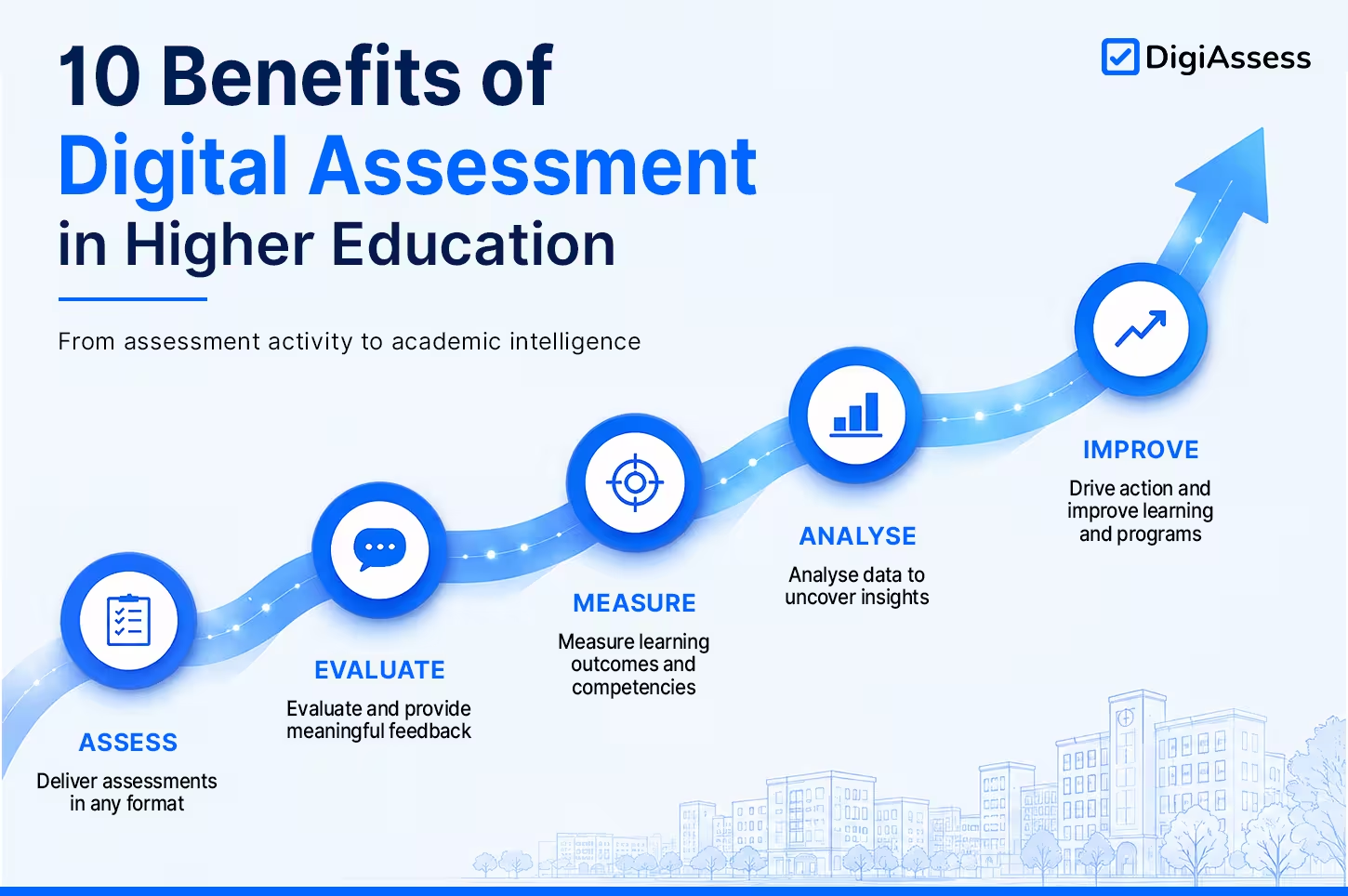
This is represented through the DigiAssess Continuous Assessment Intelligence Lifecycle:
Assessment creates evidence.
Evaluation gives that evidence context.
Measurement connects it with learning outcomes and competencies.
Analysis helps reveal patterns and gaps.
Improvement turns those insights into academic action.
The goal is to help colleges and universities get more value from the assessment activity they are already conducting.
The immediate benefits of digital assessment can be operational.
Less manual coordination.
Faster evaluation.
More consistent processes.
Greater scalability.
But the longer term value is academic.
Assessment evidence can become easier to understand, easier to connect, and easier to use.
That creates a progression beyond simply moving from paper to digital:
For colleges and universities, that is where digital assessment can make the greatest difference.
Not simply by changing how assessments are conducted.
But by making the evidence they generate more useful for students, faculty, programs, and institutional improvement.
Explore how DigiAssess helps colleges and universities connect assessment operations, student performance, learning outcomes, competencies, analytics, and institutional evidence through one Digital Assessment Platform.
Fill out the form to see how DigiAssess transforms academic operations