
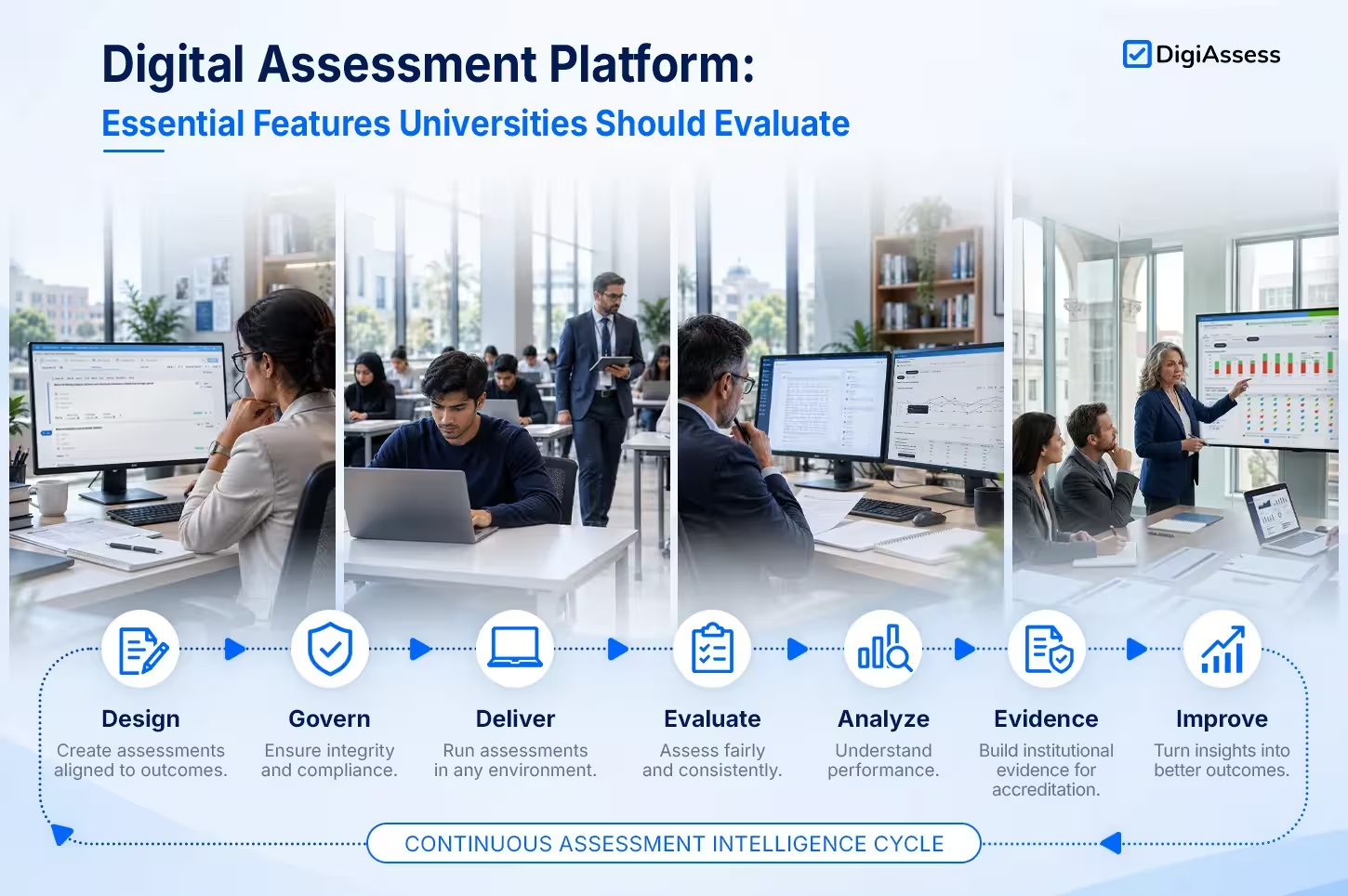
Higher education assessment is evolving beyond traditional examinations. Universities today manage different assessment models across programs, from written and continuous assessments to practical, clinical, and competency-based evaluations. At the same time, assessment needs to support academic outcomes, institutional governance, quality processes, and evidence-based improvement.
This makes choosing a digital assessment platform more than a technology decision. Institutions need to consider whether a platform can support their broader assessment requirements while providing the flexibility to adapt as academic and operational needs evolve.
DigiAssess is designed around this broader approach to digital assessment in higher education, bringing different assessment requirements into a connected environment.
But what makes a digital assessment platform suitable for a university? What should academic leaders, assessment teams, and institutional decision-makers consider before choosing one?
This article explores 11 reasons to choose DigiAssess for higher education assessment, covering the complete assessment lifecycle, assessment design and governance, learning outcomes, secure delivery, AI, practical and clinical assessment, competency development, assessment analytics, quality and accreditation, and integration with the wider university technology ecosystem.
Assessment affects more than the examination team. Faculty, students, programme leaders, administrators, quality teams, and academic leadership all depend on assessment processes and the evidence they produce.
Different programmes may also require different assessment approaches. A university may need written examinations for one programme, practical or clinical assessments for another, and competency-based or continuous assessment elsewhere. The challenge is to support this academic flexibility while maintaining consistency, governance, and institutional visibility.
Assessment data also has value beyond individual student results. It can support academic decisions, programme improvement, learning outcome measurement, quality processes, and institutional reporting.
This is why a digital assessment platform should do more than digitise examinations. It should fit into the institution’s broader assessment model and support the people, processes, and evidence involved throughout the assessment journey.
Choosing a digital assessment platform is about more than selecting individual features. Universities need an assessment environment that can support the complete assessment journey, adapt to different academic and assessment models, strengthen governance, and turn assessment data into meaningful academic insight. DigiAssess brings these requirements together through a connected approach to digital assessment, supporting everything from assessment design and secure delivery to outcomes, competencies, analytics, quality, and institutional integration. The following 11 reasons explore how DigiAssess can support the evolving assessment needs of higher education institutions.
As assessment processes become more complex, managing each stage separately can create unnecessary administrative work and make it harder to maintain visibility across the institution.
DigiAssess approaches assessment as a connected lifecycle, covering activities from assessment creation and delivery through evaluation, analysis, and improvement.
This allows institutions to bring together key assessment activities such as:
Assessment planning and design
Question bank management
Assessment delivery
Evaluation and moderation
Learning outcome measurement
Assessment analytics
Competency assessment
Reporting and evidence management
The benefit is not simply having all these capabilities in one place. It is the ability to connect the information generated across the different stages of assessment.
For a university, this can create a clearer picture of how an assessment was designed, what it measured, how students performed, and what the resulting evidence may indicate about learning and programme outcomes.
This lifecycle approach is one of the foundations of DigiAssess and its broader Assessment Operating System concept.
Good assessment starts well before the examination. Faculty need to create relevant questions, organise them properly, and select the right questions for different assessment objectives.
When question banks are spread across Word files, spreadsheets, emails, or individual faculty folders, maintaining consistency and finding the right questions can become difficult as the institution grows.
DigiAssess provides structured question bank management, giving institutions a central environment to organise and manage assessment content.
Questions can be classified based on factors such as:
Subject, topic, and question type
Difficulty and cognitive level
Course and programme
Learning outcomes and competencies
Assessment type and purpose
This makes it easier for faculty to find relevant questions and build assessments according to specific academic requirements. Instead of repeatedly creating question papers from scratch, faculty can work with a structured and reusable question repository.
The bigger advantage is that question management becomes connected to the wider assessment process. Questions are not just stored for future use; they can become part of a more structured approach to assessment design, alignment, and quality management.
An assessment should do more than produce a score. It should provide evidence that students are achieving what the course or programme intends them to learn.
This becomes especially important for institutions following outcome-based education, where assessments need to connect with Course Learning Outcomes (CLOs), Programme Learning Outcomes (PLOs), programme outcomes, and graduate attributes.
DigiAssess helps institutions connect assessment activities with these academic outcomes, creating a clearer relationship between what is taught, what is assessed, and what students are expected to achieve.
For example, an assessment can be mapped to:
Course Learning Outcomes (CLOs)
Programme Learning Outcomes (PLOs)
Programme-level outcomes
Graduate attributes
Competencies
Specific assessment criteria
This changes the way institutions can look at assessment data. Instead of asking only, “What score did the student receive?”, academic teams can also ask, “What learning outcome does this assessment provide evidence for?”
That distinction matters because outcome-level evidence can help faculty and academic leaders identify areas of strength, recognise learning gaps, and understand whether assessment is actually measuring the intended outcomes.
Over time, this can support better curriculum alignment and more informed academic improvement.
As assessment processes grow across departments and programs, maintaining control over who can create, review, approve, modify, and evaluate an assessment becomes increasingly important.
A university may have several faculty members and administrators involved in the same assessment, so relying on emails, spreadsheets, or informal approvals can make the process difficult to track.
DigiAssess brings these activities into a more structured assessment governance workflow, helping institutions define responsibilities and maintain better control throughout the assessment lifecycle.
Key governance capabilities can include:
Approval workflows to move assessments through the appropriate review stages
Roles and permissions to control who can access or modify assessment information
Assessment controls to protect sensitive assessment content and processes
Audit trails to provide visibility into important activities and changes
Moderation workflows to support review and quality checks
Version control to help track changes to assessment content
This becomes particularly valuable for high-stakes assessments, where institutions need to know not only what assessment was conducted, but also how it was created, reviewed, approved, and managed.
By bringing governance into the assessment workflow, DigiAssess helps institutions create greater accountability and traceability without adding unnecessary complexity to everyday academic processes.
For a deeper look at the governance requirements universities should consider, see the Assessment Governance Checklist for Higher Education.
For a university, moving an assessment online is not simply about putting questions on a screen. The institution also needs to make sure the right students can access the assessment, the assessment runs as intended, and the process remains secure from start to finish.
DigiAssess supports institutions in managing different assessment environments, including:
Online and campus-based assessments
Remote assessments
High-stakes examinations
Hybrid assessment models
Candidate management and access
Assessment security and control mechanisms
This flexibility is important because not every assessment follows the same delivery model.
A university may conduct a high-stakes examination on campus, run a continuous assessment remotely, and use a hybrid approach for another programme.
The platform provides a structured environment for managing these different scenarios while allowing institutions to apply the security and operational controls appropriate to each assessment.
For higher education institutions, the goal is not simply to make an examination digital. It is to create a reliable and controlled assessment experience for students, faculty, and administrators while keeping the wider assessment process connected.
AI is becoming an important part of digital assessment, particularly in areas such as assessment integrity, evaluation, monitoring, and analysis.
But for higher education institutions, the goal should not be to let AI make academic decisions on its own. The more useful approach is to use AI to support faculty and assessment teams while keeping people at the centre of important decisions.
DigiAssess brings AI-powered capabilities into the assessment environment, including areas such as AI proctoring, integrity monitoring, AI-assisted evaluation, and assessment intelligence.
For example, AI can help identify assessment activity that may require further review, reducing the need for academic teams to manually monitor every signal. It can also assist with selected evaluation and analysis workflows, helping faculty spend more time on academic interpretation rather than repetitive tasks.
At the same time, important decisions should remain subject to appropriate institutional policies and human review.
A potential integrity flag, for example, should be treated as something to investigate rather than automatically as proof of misconduct.
This approach allows institutions to benefit from AI while maintaining the principles that matter in higher education:
AI assists; academics decide.
Potential integrity issues are reviewed by people.
AI-generated insights should remain transparent and contextual.
Institutional policies and academic standards remain central.
For DigiAssess, AI is therefore not about replacing academic judgment. It is about using technology to make assessment processes more intelligent, efficient, and manageable while keeping academic responsibility with the institution.
Not every important skill can be measured through a written examination.
In disciplines such as medicine, nursing, healthcare, and other professional programmes, students also need to demonstrate how they apply knowledge in practical and real-world situations.
This is where traditional online examination systems can become limiting. They are generally designed around questions, answers, and scores, while practical and clinical assessments often require observation, structured criteria, multiple evaluators, and evidence of actual performance.
DigiAssess extends digital assessment into these areas, supporting assessment models such as:
Practical assessments
Clinical assessments
OSCEs
Skills-based assessments
Structured evaluations
Digital assessment evidence
Instead of relying on paper checklists or disconnected spreadsheets, faculty and evaluators can work within a more structured digital workflow.
Assessment criteria, evaluations, and student performance can be captured as part of the wider assessment record.
This also makes the resulting evidence more useful beyond the individual assessment. Practical and clinical assessment data can contribute to understanding student competencies, learning outcomes, and overall academic progress.
For institutions with programmes that depend heavily on practical or clinical performance, this broader capability is important because digital assessment should not stop at the examination hall. It should also support how students demonstrate what they can actually do.
In many higher education programmes, a student’s readiness cannot be understood through examination scores alone.
Students may need to demonstrate that they can apply their knowledge, perform specific tasks, and develop the competencies expected in their profession. This is especially relevant in healthcare, engineering, vocational, and other practice-oriented programmes.
Competency-based assessment looks at this development over time.
Instead of relying on a single examination, institutions may need to collect evidence from multiple observations, practical activities, workplace experiences, evaluations, and portfolios.
DigiAssess supports this broader approach by bringing competency and workplace-based assessment into the digital assessment environment.
Institutions can work with assessment evidence such as:
Competency frameworks and defined criteria
Workplace-based assessments
Practical observations and evaluations
Portfolio-based evidence
Repeated assessments over time
Competency progression and achievement
Through capabilities such as DigiPortfolio, this evidence can become part of a more structured assessment record rather than remaining in separate documents or manual records.
The real value is being able to see the student’s development as a journey rather than as a collection of individual scores.
Faculty and academic teams can use the available evidence to understand where a student has demonstrated a competency, where further development may be needed, and how assessment contributes to overall graduate readiness.
This makes digital assessment more relevant to programmes where the most important question is not simply “What did the student score?”, but “What can the student demonstrate in practice?”
Every assessment generates data, but data by itself does not necessarily help a university make better decisions.
A final score can tell you how a student performed, but it may not explain why the performance looks that way or what the institution should look at next.
This is where assessment analytics becomes valuable.
DigiAssess helps institutions look beyond overall marks and examine the patterns within their assessment data.
Academic teams can explore areas such as:
Question and item performance to identify questions that may need review
Student and cohort performance to understand broader learning patterns
Learning outcome performance to see where students are achieving or struggling
Competency trends to track development across assessments
Assessment quality to identify patterns that may require academic attention
For example, if students consistently perform poorly on questions mapped to a particular learning outcome, that pattern may prompt faculty to look more closely at the assessment design, curriculum coverage, or student learning.
Similarly, unusual question-level performance may indicate that an item needs to be reviewed rather than simply assuming that students performed poorly.
The important point is that analytics should not become another collection of dashboards that nobody uses.
The real value comes when data leads to insight, and insight supports an academic decision.
With DigiAssess, assessment data can therefore become more than a record of what happened. It can help institutions understand their assessments, identify patterns, and use evidence to support continuous improvement.
For universities, assessment evidence does not end with publishing student results.
The same assessment data may later be needed for programme reviews, internal quality processes, accreditation activities, and academic decision-making.
The challenge is often not generating the evidence, but keeping it organised and being able to trace where it came from.
DigiAssess helps institutions bring assessment information into a more structured environment, making it easier to connect assessment activities with the evidence they generate.
This can include:
Learning outcome evidence from mapped assessments
Competency evidence from practical, clinical, or workplace assessments
Assessment quality data from evaluation and analysis
Reports and analytics for academic and institutional review
Traceable assessment records that show how evidence was generated
Structured evidence that can support quality assurance and accreditation processes
For example, when an assessment is linked to specific learning outcomes, the resulting performance data can provide evidence that is useful beyond the individual examination.
Over time, institutions can build a clearer picture of how assessment contributes to programme outcomes and student achievement.
This can make quality reviews more structured because academic and quality teams are working with assessment evidence generated through the institution’s normal processes rather than trying to reconstruct everything manually when a review or accreditation exercise begins.
It is important to make one distinction, however: DigiAssess supports accreditation-related assessment evidence and quality processes; it does not automatically make an institution accreditation-ready.
Accreditation requirements vary by country, regulator, discipline, and accrediting body. The platform’s role is to help institutions organise, connect, analyse, and report the assessment evidence needed to support their existing academic quality processes.
A university rarely runs on a single software system.
Student information may sit in an SIS, learning activities in an LMS, administrative data in an ERP, and identity information in another system. Assessment needs to work alongside these systems rather than becoming another isolated application.
This is why integration is an important consideration when choosing a digital assessment platform.
When systems are connected properly, institutions can reduce repetitive data entry and make it easier for relevant information to move between academic and assessment workflows.
DigiAssess is designed with this connected environment in mind, supporting areas such as:
LMS integration for connecting learning and assessment activities
SIS integration for student and academic information
ERP connectivity where institutional processes require it
APIs and data exchange for connecting other applications
Identity and user management to support controlled access
Results integration so assessment outcomes can flow into relevant institutional systems
DigiAssess’s INTEGER integration layer is designed to support this exchange of information between assessment and the wider university technology ecosystem.
The benefit is simple: faculty and administrators should not have to repeatedly enter the same information into multiple systems just because assessment happens in a separate application.
For institutions, the goal is not to replace the systems they already depend on. It is to make assessment fit into the existing digital architecture, so that assessment data can move where it is needed while the institution maintains a more connected view of its academic processes.
Taken together, these 11 reasons point to a broader shift in how universities can approach assessment.
The value of a digital assessment platform is not necessarily in any single capability. It comes from how different assessment processes, academic requirements, evidence, and systems can work together across the institution.
From assessment planning and design to delivery, evaluation, and reporting, institutions can move toward more connected assessment operations rather than managing each stage separately.
Governance, learning outcomes, competencies, and human oversight of AI help institutions maintain academic control while supporting different assessment models.
Assessment data can become more useful when it is connected to learning outcomes, competencies, quality processes, and academic decision-making. This can help institutions move from simply recording results to using assessment evidence for improvement.
Different assessment types, technologies, and institutional systems need to work together. Connecting examinations with practical assessment, competency development, analytics, and existing university systems can help create a more consistent assessment environment.
Ultimately, these 11 reasons are not about choosing individual features. They are about whether a higher education assessment platform can support assessment as a connected institutional process.
For higher education institutions, digital assessment is moving beyond simply conducting examinations online. Assessment now spans design, delivery, evaluation, outcomes, competencies, analytics, quality, and continuous improvement.
The shift can be understood simply:
Traditional approach
Examination → Result
Connected assessment approach
Assessment Design → Delivery → Evaluation → Outcomes → Analytics → Improvement
This broader approach requires assessment to work across different academic contexts rather than operate as an isolated examination system. DigiAssess brings these capabilities together through a connected Academic Digital Ecosystem designed to connect assessment, intelligence, quality, and academic operations.
For institutions looking at how assessment can work across different learning environments, the earlier guide Digital Assessment Solutions That Work in Every Learning Environment provides additional context.
The goal is not simply to digitise an existing examination process. It is to create a more connected assessment environment where evidence can move from assessment to insight, from insight to academic decisions, and ultimately toward continuous improvement.
Choosing a digital assessment platform requires more than comparing feature lists. Universities need to consider whether a platform can support their academic, operational, governance, and technology requirements as assessment continues to evolve.
The specific capabilities that institutions should evaluate are explored in our detailed guide, Digital Assessment Platform Features: 12 Capabilities Universities Should Evaluate.
In this article, we take a different approach: instead of looking at capabilities individually, we focus on 11 reasons why higher education institutions may choose DigiAssess as their assessment platform.
Choosing a digital assessment platform is ultimately about choosing an approach that can support the institution across its academic, operational, and governance requirements.
The 11 reasons explored in this article show how DigiAssess brings assessment design, delivery, evaluation, outcomes, competencies, AI, analytics, quality, accreditation support, and technology integration into a connected assessment environment.
Rather than treating assessment as a series of disconnected activities, DigiAssess is designed to help institutions manage the broader assessment lifecycle while maintaining the flexibility needed across different programs and assessment models.
For universities looking to build a more connected, intelligent, and governance-focused approach to assessment, DigiAssess provides a digital assessment platform designed around the evolving needs of higher education.
Explore DigiAssess to see how your institution can connect the complete assessment journey in one environment.
Fill out the form to see how DigiAssess transforms academic operations