
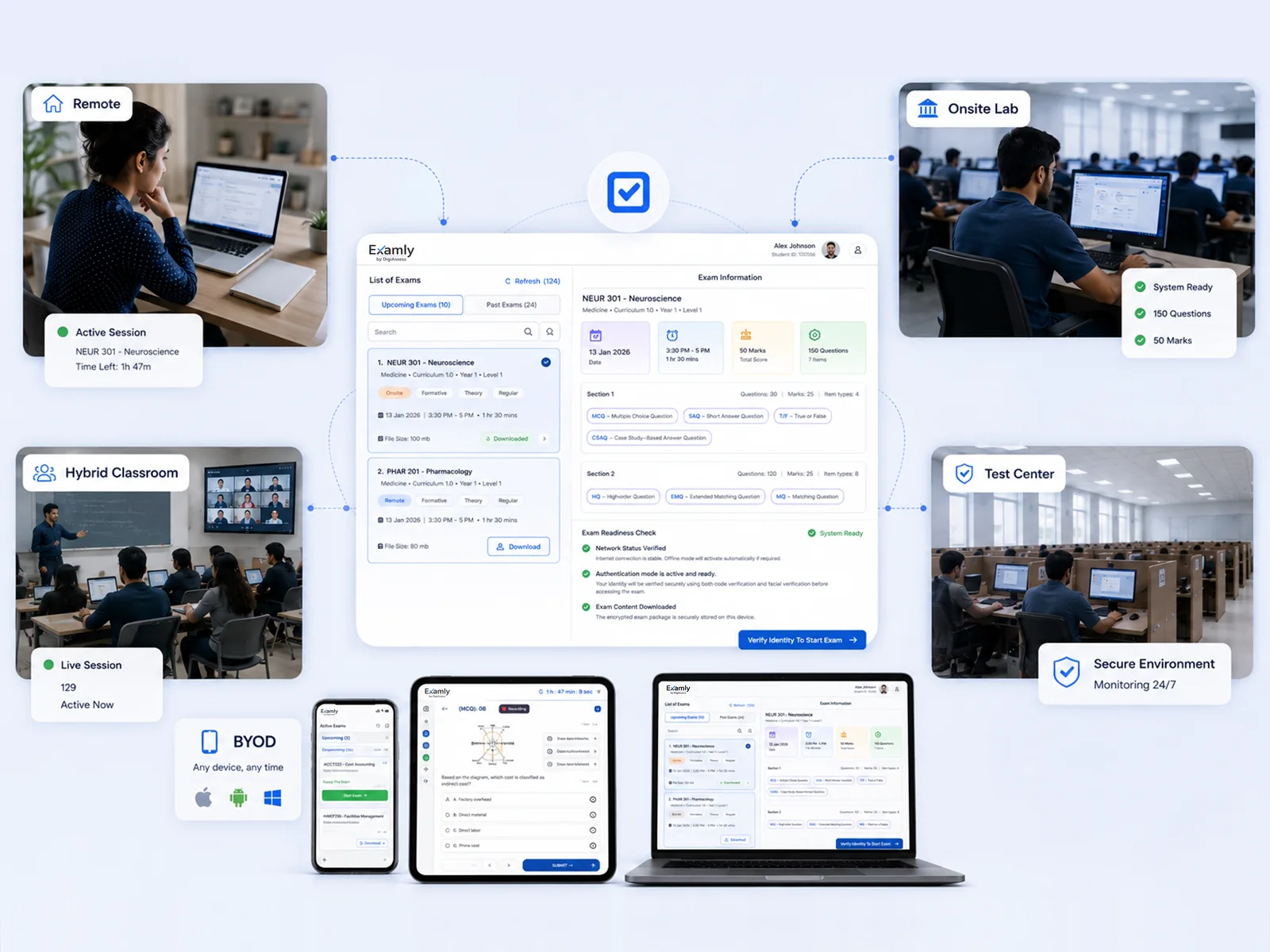


Use this checklist to review your current assessment environment, or a new platform, against the requirements of secure, controlled examinations.
Why this checklist is needed in times of regional uncertainty
During periods of regional uncertainty, the ability of universities and colleges to maintain stable academic operations becomes especially important. Students expect examinations to be conducted on time, faculty must complete evaluation and grading, and institutions must continue to meet accreditation and regulatory requirements regardless of external conditions. When the assessment process is not fully supported by a reliable digital system, even small disruptions can create significant academic and administrative difficulties.
Many institutions currently rely on a combination of Learning Management System quizzes, manual scheduling, spreadsheets, and separate tools to manage examinations. While this approach may work during normal academic cycles, it often becomes difficult to manage when exams must be conducted remotely, across multiple locations, or under strict time constraints. Systems that were designed mainly for course delivery may not provide the level of control required for high-stakes assessment, identity verification, centralized scheduling, or secure evaluation.
Another challenge during uncertain situations is that assessment must continue without compromising integrity. Universities and colleges must ensure that exam rules are applied consistently, incidents are recorded properly, and results can be defended if questioned later. When policies are not digitized and workflows are not controlled by the system, maintaining consistent standards across departments and campuses becomes difficult.
Institutions may also face pressure to complete assessments quickly so that students can graduate on time or progress to the next academic stage. In such cases, manual processes and disconnected tools increase the risk of errors, delays, and incomplete reporting. Problems that might be manageable during routine operations can become serious when academic schedules must be protected.
For these reasons, decisions about assessment platforms should not be based only on whether the system can deliver online tests. Universities and colleges need to confirm that the platform can support the full assessment lifecycle, including planning, security, scheduling, evaluation, reporting, policy enforcement, and accreditation documentation.
A structured checklist helps institutions review all these areas before selecting or upgrading a digital assessment platform. By examining each requirement carefully, academic leaders can ensure that their assessment environment is capable of maintaining continuity with security and integrity, even in challenging conditions.
What this checklist helps universities and colleges do
This checklist is designed to help universities and colleges review their current assessment environment and determine whether their digital systems are capable of supporting examination continuity under all conditions. Rather than focusing only on basic online testing features, the checklist evaluates the full set of functions required to manage assessment at the institutional level, including planning, security, scheduling, evaluation workflows, reporting, policy control, and accreditation support.
By using this checklist, institutions can identify weaknesses that may not be visible during normal academic operations. In many cases, universities discover that important parts of the assessment process depend on manual work, separate applications, or informal procedures. These gaps may not cause problems in routine situations, but they can create serious risks when examinations must be conducted under time pressure, across multiple locations, or using different delivery modes.
The checklist also helps institutions compare different digital assessment platforms in a structured way. Demonstrations and feature lists often focus on individual functions, such as online exams or question banks, but they do not always show whether the system can support the entire assessment process. Reviewing each item in the checklist allows decision makers to confirm that the platform can handle institutional requirements, not only classroom-level activities.
Another important benefit of the checklist is preparation for situations where normal academic procedures cannot be followed. When exams must be conducted remotely, when campuses operate under restrictions, or when schedules must be adjusted quickly, the assessment platform must provide flexibility without losing control. Institutions that have reviewed their systems in advance are more likely to maintain stability and avoid last-minute difficulties.
The checklist also supports universities and colleges in maintaining academic integrity during challenging periods. Secure exam delivery, identity verification, incident recording, and controlled evaluation workflows are essential for protecting the credibility of results. A platform that cannot enforce institutional policies consistently may expose the institution to academic and regulatory risk.
In addition, the checklist helps ensure that reporting and documentation can continue without interruption. Accreditation bodies, quality assurance units, and academic leadership may still require outcome reports, course reports, and evidence of assessment even when exams are conducted under unusual conditions. A complete assessment platform should allow these reports to be generated automatically from the system.
By completing this checklist, universities and colleges gain a clearer understanding of whether their current environment is ready to support examination continuity with security and integrity, and whether additional capabilities are required to maintain academic stability in the present regional situation.
How to use this checklist
This checklist is intended to be used by universities and colleges that are reviewing their current assessment systems or evaluating a new digital assessment platform to ensure examination continuity in times of regional uncertainty. Because assessment affects multiple parts of the institution, the checklist should be completed by a group rather than by a single individual. Examination offices, academic leadership, quality assurance teams, and information technology departments should all participate in the review.
Each item in the checklist should be marked as Yes, No, or Not Applicable, depending on whether the current system or the proposed platform supports the required capability. A “Yes” indicates that the function is fully supported at the institutional level. A “No” indicates that the function is missing or requires manual workarounds. “Not Applicable” may be used if a particular requirement does not apply to the institution, although most universities and colleges will find that many of the listed areas are relevant when examinations must continue under uncertain conditions.
The checklist can be used in several ways. Institutions may review their existing environment to determine whether their current tools are sufficient. It can also be used when comparing different digital assessment platforms, allowing decision makers to evaluate each system against the same set of requirements. Completing the checklist for more than one product makes it easier to see which platform can support secure and reliable assessment during challenging situations.
It is recommended that the checklist be completed carefully and without assumptions. A feature should only be marked as supported if it can be used in real institutional operations, not only in demonstrations. This approach helps prevent problems that may appear later when the system is used at scale.
An interactive spreadsheet version of the checklist may also be used so that responses can be recorded, shared with different departments, and reviewed collectively. This allows the institution to make decisions based on documented requirements rather than informal discussions.
The checklist should be reviewed whenever there are changes in exam delivery methods, institutional policies, or external conditions that may affect academic operations. Regular review helps ensure that the assessment platform remains capable of maintaining examination continuity with security and integrity.
Digital Assessment Platform Readiness Checklist
The following checklist outlines the key functional areas that universities and colleges should review when evaluating whether their current assessment system, or a new digital assessment platform, is capable of maintaining examination continuity with security and integrity in times of regional uncertainty. The checklist covers the full lifecycle of institutional assessment, including exam planning, scheduling, security, evaluation workflows, reporting, policy enforcement, and accreditation readiness.
The items are organized into sections that reflect the operational requirements of modern higher education. These requirements go beyond classroom-level testing and focus on the needs of the institution as a whole. When examinations must be conducted across multiple campuses, in hybrid or remote formats, or under time constraints, the assessment platform must provide centralized control and consistent enforcement of academic rules.
This checklist may be used to review the existing academic digital ecosystem or to evaluate a new assessment platform before implementation. By examining each area carefully, universities and colleges can confirm whether their current environment is capable of supporting secure and reliable assessment even when normal academic conditions are affected.
Institutions are encouraged to complete the checklist with participation from examination departments, academic leadership, quality assurance units, and information technology teams. A structured review helps ensure that important requirements are not overlooked and that decisions about assessment platforms are based on institutional needs rather than assumptions.
An interactive version of the checklist can also be used in spreadsheet format to record responses, compare systems, and review results collectively.
The checklist begins below.
Digital Assessment Platform Continuity & Integrity Checklist for Universities and Colleges
Mark: Yes / No / N/A
Section 1 — Assessment Modes & Continuity Capability
| Item |
|---|
| Supports onsite exams without disruption |
| Supports remote exams when campus access is limited |
| Supports hybrid exams across locations |
| Supports exams across multiple campuses |
| Supports practical / clinical exams digitally |
| Supports oral / viva exams remotely |
| Supports workplace-based / field assessment |
| Supports multiple exam formats in same session |
Section 2 — Security & Integrity During Disruption
| Item |
|---|
| Student identity verification available |
| Secure exam environment available |
| Integrity rules configurable per exam |
| Monitoring available during remote exams |
| Activity logs stored for review |
| Incident recording during exam supported |
| High-stakes exam security controls available |
| Role-based access control enforced |
Section 3 — Exam Operations Under Changing Conditions
| Item |
|---|
| Centralized exam scheduling available |
| Exams can be rescheduled quickly |
| Multi-course scheduling supported |
| Multi-campus scheduling supported |
| Student allocation automatic |
| Invigilator / proctor assignment supported |
| Real-time exam monitoring available |
| Exam status dashboard available |
Section 4 — Evaluation Workflow Stability
| Item |
|---|
| Rubric-based evaluation supported |
| Checklist evaluation supported |
| Multiple evaluator scoring supported |
| Evaluation approval workflow available |
| Result review before release |
| Evaluation audit trail stored |
| Station / multi-part exam evaluation supported |
Section 5 — Outcome Measurement Continuity (CLO / PLO)
| Item |
|---|
| CLO mapping supported |
| PLO mapping supported |
| Outcome calculation automatic |
| Course outcome reports available |
| Program outcome reports available |
| Longitudinal tracking supported |
Section 6 — Direct & Indirect Measurement Availability
| Item |
|---|
| Exam results linked to outcomes |
| Survey results linked to outcomes |
| Direct + indirect measurement combined |
| Course evaluation supported |
| Program evaluation supported |
| Feedback analysis available |
Section 7 — Reporting & Documentation Without Interruption
| Item |
|---|
| Course reports auto-generated |
| Program reports auto-generated |
| Outcome reports available |
| Exam statistics available |
| Evidence stored in system |
| Documents attached to exams |
| Audit trail available |
Section 8 — Integration with SIS / LMS / QA Systems
| Item |
|---|
| SIS integration available |
| LMS integration available |
| Survey / feedback integration |
| QA / accreditation integration |
| Data export supported |
| API / sync supported |
Section 9 — Crisis & Continuity Readiness
| Item |
|---|
| Remote exams ready at any time |
| Hybrid exams supported |
| Exams across locations supported |
| Works under high load |
| Quick exam setup possible |
| Emergency rescheduling supported |
| Monitoring during disruption available |
Section 10 — Institutional Policy Enforcement
| Item |
|---|
| Exam policies configurable |
| Integrity rules configurable |
| Planning rules configurable |
| Conduction rules configurable |
| Approval workflow configurable |
| Different rules per program |
| Different rules per exam |
| Policy audit trail stored |
Section 11 — Discipline & Incident Management
| Item |
|---|
| Violation logging supported |
| Incident recording available |
| Discipline workflow supported |
| Evidence attachment supported |
| Committee review tracking |
| Integrity reports available |
| Student misconduct history stored |
Section 12 — Seat / Hall / Center Allocation
| Item |
|---|
| Hall allocation supported |
| Seat allocation supported |
| Lab / device allocation supported |
| Multi-center exams supported |
| Automatic seating supported |
| Seat change supported |
| Invigilator allocation supported |
Section 13 — Competency / EPA / Professional Framework
| Item |
|---|
| Competency framework supported |
| Domain / milestone tracking |
| EPA tracking supported |
| Longitudinal competency tracking |
| Multi-assessor evaluation |
| Competency reports available |
| Programmatic assessment supported |
Section 14 — Accreditation & Regulatory Readiness
| Item |
|---|
| Accreditation reports available |
| Course reports auto generated |
| Program reports auto generated |
| Outcome reports available |
| Competency reports available |
| Evidence linked to reports |
| ABET / national reports possible |
| Audit trail available |
Section 15 — Customization & Institutional Flexibility
| Item |
|---|
| Workflows configurable |
| Policies configurable |
| Rules per program supported |
| Rules per course supported |
| Rules per exam supported |
| Custom grading rules |
| Custom reports supported |
| Custom roles supported |
| Multi-campus configuration |
| Adaptable without coding |
Interactive Checklist Version
To support institutional review, this checklist may also be used in an interactive spreadsheet format. The spreadsheet allows universities and colleges to record responses, share the checklist with different departments, and review the results collectively. This approach is especially useful when decisions about assessment platforms involve examination offices, academic leadership, quality assurance teams, and information technology departments.
Using the checklist in spreadsheet form makes it possible to identify areas where the current academic digital ecosystem is strong and areas where additional capabilities may be required. Institutions may also use the spreadsheet to compare different digital assessment platforms by completing the checklist for each system and reviewing the results side by side.
A structured review helps ensure that important requirements are not overlooked, especially when examinations must continue under changing conditions. Instead of relying only on demonstrations or feature descriptions, decision makers can verify whether the platform can support real institutional operations during both normal and uncertain situations.
The interactive checklist can be accessed using the link below:
- Download the checklist in Excel and PDF
Institutions may copy the spreadsheet, complete the checklist internally, and use the results to guide decisions about selecting or upgrading a digital assessment platform to ensure examination continuity with security and integrity.
What institutions gain after completing this checklist
Completing this checklist provides universities and colleges with a clear understanding of whether their current assessment environment is capable of maintaining stable academic operations in the present regional situation. Instead of assuming that existing tools are sufficient, institutions are able to review each critical requirement in a structured and objective manner.
One of the main outcomes of using the checklist is the ability to identify risks before they affect examinations. In many cases, institutions discover that certain functions depend on manual work, disconnected systems, or temporary solutions. These limitations may not cause problems during normal academic cycles, but they can become serious when exams must be conducted remotely, across multiple locations, or under time constraints. By reviewing all required areas, institutions can determine whether their current platform can maintain continuity without disruption.
The checklist also supports better decision making when selecting a digital assessment platform. Demonstrations and feature lists often show only part of the system, while institutional
assessment requires many functions to work together. By reviewing each section of the checklist, academic leaders can confirm whether the platform can support exam planning, security, scheduling, evaluation workflows, reporting, policy enforcement, and accreditation requirements in a consistent and reliable way.
Another important outcome is improved readiness for accreditation and quality assurance. Even during periods of uncertainty, universities and colleges must continue to provide evidence of assessment, outcome achievement, and academic control. When the assessment platform supports automated reporting and proper documentation, institutions can maintain compliance without additional manual work.
The checklist also helps institutions prepare for situations where normal exam procedures cannot be followed. Remote exams, hybrid delivery, distributed campuses, and rapid schedule changes require systems that are flexible but still controlled. Universities and colleges that review their assessment environment carefully are more likely to maintain security and integrity while continuing academic activities.
Finally, completing the checklist gives academic leadership confidence that the institution is prepared not only for regional uncertainty but also for future changes. As digital learning expands and assessment becomes more complex, having a reliable and configurable digital assessment platform becomes essential for protecting academic standards and ensuring institutional stability.
Conclusion
In regional uncertainty, universities and colleges carry a significant responsibility to maintain academic continuity while protecting the integrity and credibility of their assessment processes. Students must be able to complete their examinations, faculty must be able to evaluate performance correctly, and institutions must continue to meet accreditation and regulatory requirements even when external conditions create uncertainty.
Many academic digital ecosystems are built around Student Information Systems and Learning Management Systems, which are essential for administration and teaching. However, these platforms alone may not provide the level of control required to manage secure and reliable assessment during periods of disruption. When examinations must be conducted across multiple locations, in remote or hybrid formats, or under strict timelines, the absence of a comprehensive digital assessment platform becomes more visible.
Selecting the right assessment platform is therefore a strategic decision for universities and colleges. The system must support not only exam delivery, but also institutional policies, scheduling, integrity controls, evaluation workflows, outcome measurement, reporting, and
accreditation documentation. A platform that cannot manage these functions consistently may create risks that affect students, faculty, and the institution as a whole.
The checklist provided in this article offers a practical way to review these requirements in a structured manner. By carefully evaluating each area, institutions can identify gaps in their current environment, compare available platforms more effectively, and ensure that their academic digital ecosystem is capable of maintaining examination continuity with security and integrity.
Universities and colleges that prepare their assessment environment in advance are better positioned to protect academic standards, support student progression, and continue operations confidently, regardless of the challenges created by regional uncertainty.


