
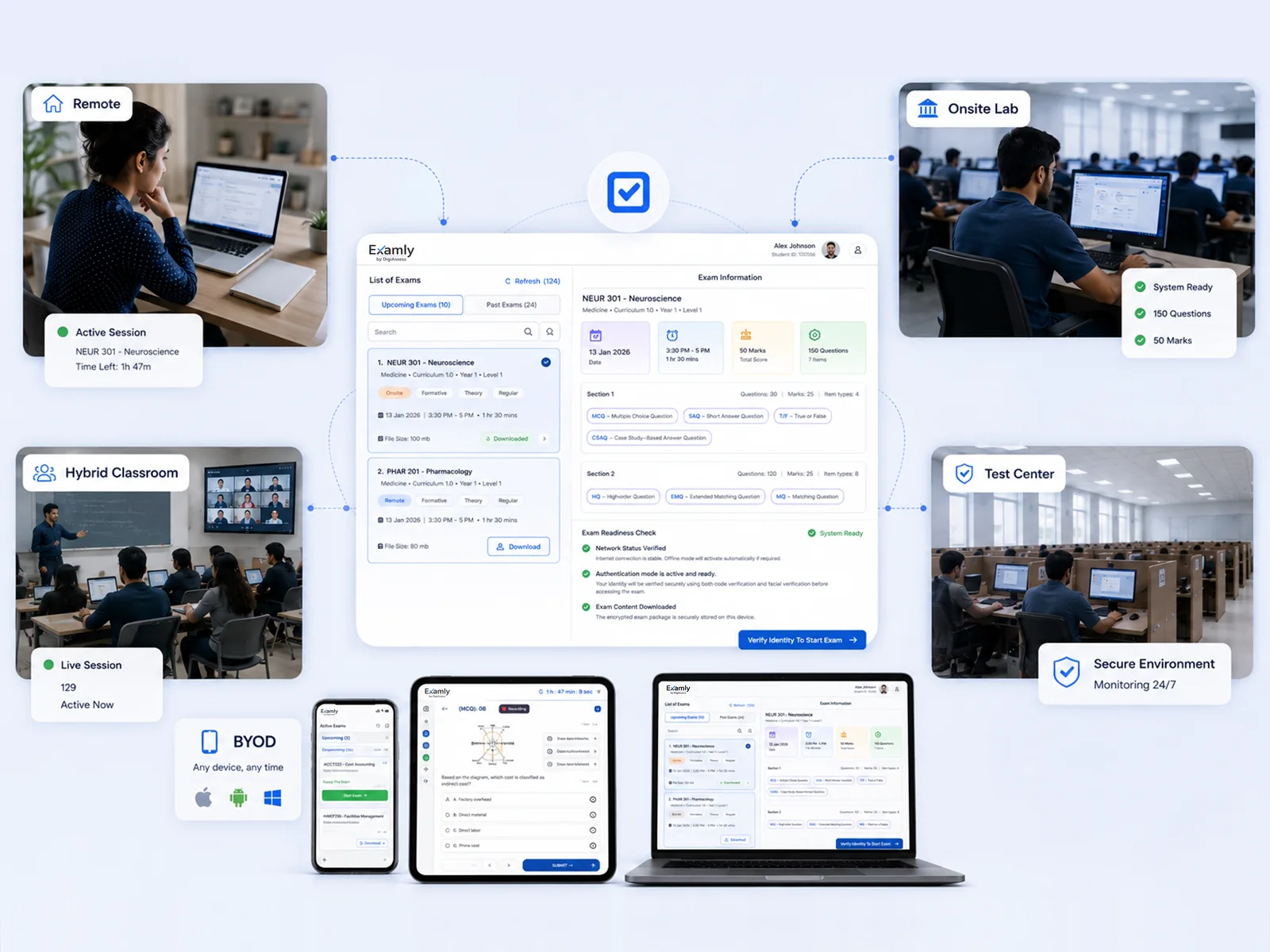


Overview
Most institutions run on two foundational systems: the Student Information System (SIS) and the Learning Management System (LMS). They are necessary, but they leave a gap in assessment governance and outcome assurance. That gap becomes visible under scrutiny, disruption or accreditation review.
This whitepaper defines the AI-Powered Assessment Operating System (AOS) as a dedicated assessment governance, operations, assurance and intelligence layer that integrates with the SIS and LMS. It describes a closed-loop academic flow: SIS, LMS, AOS, quality assurance, accreditation and analytics, and back to the SIS. Its conclusion is that institutions do not need more disconnected tools. They need one governed assessment operating system that completes the academic digital ecosystem.
Introduction
The Hidden Gap in Academic Digital Transformation
For more than a decade, higher education institutions across the world have been on a journey of digital transformation. This transformation has largely been defined by the adoption of two foundational systems: the Student Information System (SIS) and the Learning Management System (LMS). Together, these systems have enabled institutions to manage student data, deliver learning content, conduct basic assessments, and maintain academic continuity at scale.
From an operational standpoint, this has been a significant advancement. Institutions today are able to run complex academic programs across campuses, manage thousands of students, and deliver structured learning experiences in both physical and digital environments. The system appears complete. The infrastructure appears sufficient. And in many cases, the transformation is considered achieved.
However, beneath this perception of completeness lies a deeper structural gap that does not immediately surface in routine operations, but becomes critically visible under conditions of scrutiny, disruption, or accountability.
This gap is not in teaching, data management, and content delivery. It is in the assessment governance and outcome assurance.
In most institutions, assessment continues to be treated as an extension of learning systems. It is conducted through LMS quizzes, supported by standalone exam tools, and secured through proctoring solutions.
While these approaches enable the execution of exams, they do not establish a governed system of assessment that can assure outcomes, validate competencies, and support institutional decision-making. This distinction is fundamental.
Because in the current academic landscape, institutions are no longer evaluated based on whether they conducted assessments. They are evaluated based on whether they can demonstrate, with evidence, that learning outcomes and competencies have been achieved, validated, and trusted.
This challenge became particularly visible during periods of disruption such as the COVID pandemic, and more recently in regional uncertainties affecting academic continuity. Institutions demonstrated remarkable resilience in continuing teaching and conducting examinations under constrained conditions. Systems adapted. Processes continued. Students progressed.
But an important question remained and often unspoken, yet deeply understood:
- Were the outcomes truly achieved?
- Were the competencies fully demonstrated?
- Could those results be confidently relied upon in real-world application?
In one such academic discussion during the pandemic, the concern was not about whether an examination could be conducted, but whether a critical clinical competency such as
performing an endotracheal intubation in a trauma case; could be meaningfully delivered, assessed, and validated under restricted conditions.
The system allowed progression. But it could not fully assure competency. “Continuity of assessment does not necessarily ensure continuity of competence.”
This realization marks a shift in how assessment must be understood.
Assessment is not merely an academic checkpoint. It is the control point of truth within the academic system. It determines:
- Whether learning has actually occurred
- Whether outcomes have been achieved
- Whether competencies are demonstrable
- Whether graduates are ready for real-world roles
- Whether institutions can stand accountable to regulators and accreditation bodies
And yet, despite this central importance, assessment remains one of the least systematized and most fragmented components of the academic digital ecosystem.
The root of this issue lies in how the academic digital ecosystem has evolved.
- SIS provides structure. - LMS provides delivery.
But there is no dedicated layer that:
- Governs the full lifecycle of assessment
- Ensures alignment between learning, assessment, and outcomes
- Integrates multiple assessment modalities (theory, practical, clinical, workplace-based)
- Enables real-time measurement and validation of competencies
- Produces continuous, audit-ready evidence for accreditation
- Supports structured, data-driven academic improvement
- As a result, institutions often rely on:
- Spreadsheets for outcome mapping
- Manual compilation of course and program reports
- Disconnected tools for different assessment types
- Retrospective data reconciliation for accreditation
This is not a limitation of effort. It is a limitation of system design.
- “When assessment is not governed as a system, outcomes may be reported but they cannot always be trusted.”
This is where the concept of an AI-Powered Assessment Operating System (AOS) emerges; not as another tool, but as a necessary evolution in the architecture of academic systems.
An AOS introduces a dedicated layer that governs, integrates, and assures the entire assessment lifecycle from planning and design to evaluation, validation, reporting, and continuous improvement, while working seamlessly with existing SIS and LMS environments. It transforms assessment from an activity into a structured institutional system.
At a deeper level, this also connects with the evolving need for Outcome and Competency Inventory (OCI) thinking; where assessment is not limited to measuring performance, but extends to understanding whether outcomes are delivered, assessed, validated, and ultimately, entrusted in practice. This shift moves institutions from:
- Completion → to Confirmation
- Measurement → to Assurance
- Reporting → to Intelligence
The implications of this transformation extend far beyond assessment. When implemented as part of a unified academic digital ecosystem, an AOS enables:
- Continuous academic governance
- Real-time outcome and competency intelligence
- Structured closing of the loop from learner to program
- Accreditation readiness as a continuous state, not a periodic effort
- Sustainability through reduction of paper-based assessments
- AI-driven insights for decision-making and personalization
In essence, the transition toward an AI-Powered Assessment Operating System enables institutions to:
- Move from fragmented tools to a unified academic ecosystem
- Move from exam conduction to outcome assurance
- Move from data collection to academic intelligence
- Move from compliance-driven reporting to continuous improvement
- Move from digitalization to Academic Digital Excellence
“Assessment is not where the academic process ends. It is where institutional truth is established, validated, and made accountable.”
This article explores this transformation in depth. It examines the limitations of current systems, defines the concept of an Assessment Operating System, and outlines how institutions can evolve toward a governed, integrated, and intelligent academic digital ecosystem. The journey is not about replacing what exists. It is about completing what is missing.
Related reading: Ensuring Examination Continuity When Conditions Are Uncertain, on how institutions are preparing with different strategies to protect examination integrity and continuity.
Why SIS and LMS Are Necessary but Not Sufficient
The digital transformation journey in higher education has, for the most part, been anchored around two foundational systems: the Student Information System and the Learning Management System. Institutions have invested significant time, effort, and capital in implementing these systems, and rightly so. They bring structure, scalability, and consistency to academic operations.
With SIS, institutions are able to manage student records, progression, grades, and academic history in a controlled and traceable manner. With LMS, they are able to deliver learning, manage assignments, conduct quizzes, and facilitate interaction between faculty and students across physical and digital environments.
Together, these systems have enabled institutions to operate at scale. And over time, this has created a widely accepted assumption: If an institution has SIS and LMS, it is digitally transformed. This assumption begins to weaken the moment institutions are required to demonstrate not just delivery of education, but assurance of outcomes.
Because while SIS and LMS support academic processes, they do not govern what those processes are expected to achieve. They manage activity. They do not assure outcome.
The full text of this section continues in the PDF.
Implementation Roadmap: From Fragmented Tools to Academic Digital Excellence
One of the most critical questions institutions face today is not whether transformation is required, but how it can be executed without disrupting academic continuity.
Assessment is not a peripheral function. It is deeply embedded into academic operations. It influences student progression, faculty workflows, accreditation outcomes, and institutional credibility. Any change to this layer must therefore be handled with precision, structure, and clarity.
For many institutions, the challenge is not a lack of systems. It is the presence of too many disconnected ones. LMS, standalone exam tools, proctoring systems, spreadsheets, and manual processes together create a fragile structure that works under normal conditions, but begins to break under scale, complexity, or crisis.
This is why transformation cannot be approached as a system replacement exercise. It must be approached as a controlled evolution of academic operations.
The full text of this section continues in the PDF.
Layer 1: System Evolution Cycle (Core AOS Loop)
This layer defines how the Assessment Operating System evolves structurally within the institution.
1. Pilot
The pilot phase is the foundation of transformation. It is not about deploying the system fully, but about validating its relevance within the institution’s academic reality.
During this phase, institutions test the system in controlled environments. They observe how it aligns with workflows, how faculty interact with it, and how it performs under real assessment conditions. The objective is to validate the capabilities and scalability to bring confidence and clarity.
The full text of this section continues in the PDF.
Layer 2: Experience Digitization Flow
While the first layer defines what the system does, this layer defines how institutions experience and evolve with it. Transformation is not only technical. It is also human, operational, and strategic.
Experience Digitization Explained:
- This layer ensures that the institution’s journey is:
- Consultative
- Adaptive
- Iterative
- Continuously improving
- 1. Consultative Approach
Every institution is unique. Its processes, culture, and academic structures differ. A consultative approach ensures that transformation begins with understanding, not implementation.
The full text of this section continues in the PDF.
Conclusion: The Need of the Hour
Across institutions worldwide, the conversation around digital transformation has largely been centered on systems. New platforms are adopted, tools are integrated, and processes are digitized. On the surface, this creates the impression of progress.
Yet, when examined closely, a critical gap remains.
Institutions have invested heavily in enabling learning through LMS and managing records through SIS. They have adopted exam tools to conduct assessments and proctoring systems to monitor integrity. Each of these plays a role. But collectively, they do not form a complete academic system.
Because what is missing is not another tool. It is a governed layer that brings structure, continuity, and meaning to assessment.
“The absence of a system is not visible when everything is working. It becomes visible when outcomes need to be assured.”
Assessment today carries responsibilities that go far beyond conducting exams.
It determines whether:
- Students are ready to progress
- Graduates are competent
- Programs meet accreditation standards
- Institutions can be trusted
These are not tool-level responsibilities. They are institution-level obligations.
When assessment is handled through fragmented tools; policies are interpreted differently, processes vary across departments, data remains siloed, outcomes are partially understood, and improvement is inconsistent. This creates a system that functions, but does not assure.
The shift required is fundamental.
- From conducting exams to governing assessment
- From generating marks to assuring outcomes and competencies
- From producing reports to enabling continuous improvement
This is where the Assessment Operating System becomes essential. It does not replace SIS or LMS. It completes them.
By introducing a dedicated assessment layer, institutions are able to:
- Govern the full lifecycle of assessment
- Ensure integrity, reliability, and validity of data
- Measure outcomes and competencies with clarity
- Generate continuous, audit-ready evidence
- Close the loop across learner, course, and program levels
- Evolve policies and systems based on real insights
“Assessment is not where the academic process ends. It is where institutional truth is established.”
The importance of this shift becomes even more evident in moments of complexity or crisis. When institutions are required to:
- Conduct large-scale remote or hybrid examinations
- Ensure integrity under constrained conditions
- Provide defensible evidence for accreditation
- Maintain continuity without compromising quality
It is not the presence of tools that determines success. It is the presence of a system that governs them.
Looking forward, the role of assessment will continue to expand. It will not only validate learning. It will shape it. Assessment data, when governed and integrated, will:
- Drive personalized learning pathways
- Enable predictive academic decision-making
- Support continuous institutional improvement
- Form the foundation of Academic Digital Intelligence
This is the direction in which higher education is evolving. And institutions that recognize this early will not only adapt. They will lead.
Our Final Reflection:
Institutions do not need more disconnected tools. They need a governed Assessment Operating System that completes the academic digital ecosystem, ensures outcome integrity and competency assurance, enables continuous, evidence-based improvement, and builds a foundation for future academic intelligence.
“The future of education will not be defined by how learning is delivered. It will be defined by how learning is measured, validated, and continuously improved.”
This page shows the opening of each section. The PDF has the full text, diagrams and references.


